
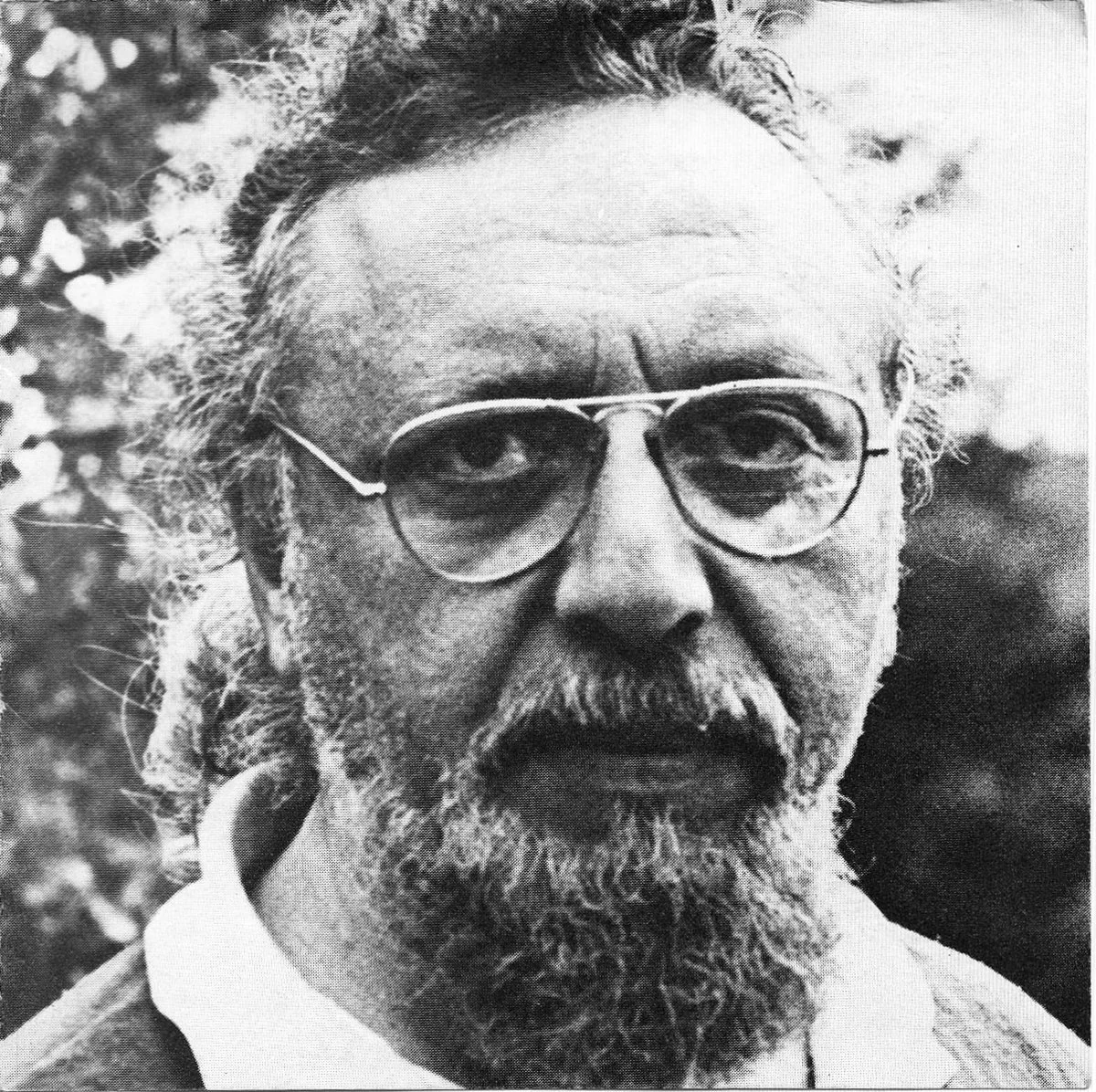
Born in Antwerp, Belgium, in 1927, Armand Schwerner emigrated with his family to New York City in 1936. Educated at Cornell, the Université de Gèneve, and Columbia University, he also studied jazz improvisation with Lennie Tristano and served a year as a musician in the US Navy. His innovative poetry began appearing in literary magazines in the nineteen fifties. The first of his many books of poetry, The Lightfall, appeared in 1963, as did The Domesday Dictionary, a satire on Cold War technocratic language, coauthored with Donald Kaplan. In the mid-sixties, Schwerner began writing The Tablets, a long sequence of “found” archaic Sumero-Akkadian clay tablets, purportedly being translated by the Scholar/Translator, who is one of Schwerner’s most inventive and comic creations. The Tablets, which Schwerner worked on throughout his entire career, belongs to the tradition of Pound’s Cantos and Eliot’s The Waste Land, with which it shares serial progression and satiric force. The depth, humor, and originality of The Tablets inspired numerous collaborations with musicians, dancers, filmmakers, and performance artists, among them the Living Theatre’s production in their 1989–1990 repertory and the multimedia spectacle Dragon Bond Rite, which was performed at the Kennedy Center in Washington, D.C., the Walker Art Museum, and New York’s Japan Society. In addition to The Tablets, Schwerner produced eight collections of poetry, including (if personal), Seaweed, The Bacchae Sonnets, The work, the joy & the triumph of the will, and Sounds of the River Naranjana. He was well known for his idiosyncratic translations from both European languages and Native American and Asian texts. His version of Sophocles’s Philoctetes was included in the Penn Greek Drama Series. At the time of his death, he was working on a translation of Dante’s Inferno, twelve cantos of which were published in 2000 as Cantos from Dante’s Inferno. Schwerner read his poetry, often in impromptu dialogues with other artists, at numerous universities and performance venues throughout the United States, Europe, and Asia. Along with his many books, his work has appeared in over forty anthologies. He taught at a number of colleges and, at his death in 1999, was Professor of English at College of Staten Island of the City University of New York.
VERGE BOOKS